
Celebrate the season with a traditional boiled Christmas pudding, rich with dried fruit, festive spices, and an aroma that will fill your home with Christmas cheer. This classic British dessert is slow-cooked to perfection, creating a dense, moist pudding that only gets better as it matures. Whether you’re carrying on a beloved family tradition or making your first Christmas pudding from scratch, this recipe delivers dependable results with minimal stress. Learn how to prepare, steam, store, and serve a pudding that will take pride of place on your Christmas desserts menu.
Before we dive in to our boiled Christmas pudding recipe, first, a brief introduction…
A short history of the Christmas pudding
Traditionally, the pudding was made the Sunday five weeks before Christmas, signalling the start of Advent. The day became known as ‘stir-up Sunday’, when every child in the household stirred the fruit mixture and made a wish. Silver coins, such as a threepenny or a sixpence, a thimble and a ring were added at this time. According to superstition, wealth would come to the finder of the coins, luck to the finder of the thimble, and impending marriage to the family of the person who found the ring in the cooked pudding.
Once known as plum pudding, due to the inclusion of prunes, the origins of Christmas pudding date back as far as the 15th century, although it only became associated with Christmas in the 1670s. Traditionally, it was made using suet, but for this version we’ve used butter instead for ease.
Before you begin: Prepare your pudding cloth
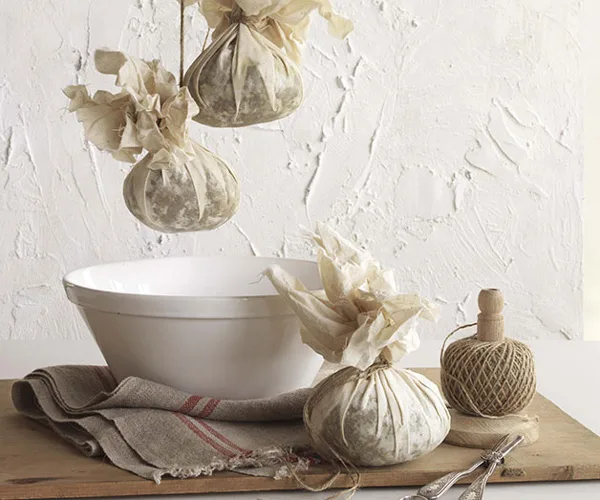
Before boiling your pudding, you’ll need to prepare your cloth and string. Soak kitchen twine and four 35cm-squares of unbleached calico (available from fabric stores) in cold water overnight. Drain your cloth and then boil it for 20 minutes. Drain again.
The below recipe will instruct you to boil your cloth once again before wringing it out, dusting it with flour and wrapping it around your pudding.
How to make a boiled Christmas pudding
You’ll need to begin this recipe a day ahead. This recipe makes four, individual small puddings.
Ingredients
Method
Combine dried and candied fruits in a bowl with sherry, mix to combine well and stand for 3 hours or overnight.
Add remaining ingredients, ½ teaspoon salt and mix to combine well.
Bring a large saucepan of water to the boil. Add one prepared pudding cloth (*see introduction) at a time to water and boil for 1 minute, then remove with tongs and squeeze excess water from cloth (wear rubber gloves to protect your hands). Place ¼ cup flour in centre of cloth and, using a flat-bottomed cup, spread flour in a 30cm-diameter circle in centre of cloth and rub in.
Pile a quarter of the pudding mixture into the centre of cloth.
Gather up edges of cloth, enclosing mixture, and twist firmly. Tie tightly with twine to seal, then tie ends of twine into long loops. Repeat with remaining pudding cloths and pudding mixture. (*See notes)
Gently lower puddings into boiling water, cover with a tight-fitting lid and cook until firm (2½-3 hours), topping up with boiling water during cooking to ensure puddings are completely submerged. Remove puddings from water with a slotted spoon, pass the handle of a wooden spoon through twine loops and hang puddings over a basin to catch drips until cloth is dry but puddings are still warm to touch (2-3 hours).
Untie puddings, peel back cloth and invert onto a plate. Cool completely, then tightly wrap each pudding in plastic wrap, place in an airtight container and refrigerate for up to 3 months or freeze for up to 1 year before using.
Tip: Use quality dried fruits
The combination of dried fruits in our recipe is merely a starting suggestion. You can make up the weight with whatever mix of dried fruit you desire. The key here is to use good-quality dried and glacé fruits and chop them up yourself. Store-bought mixed fruits are convenient, but they don’t have the same deep fruit flavour you get from using quality produce of your own choosing. The same goes for the quality of the liquor you use, too.
Notes:
- Wrapping your pudding: Make sure the mixture is completely covered with floured cloth, and that it’s as air-tight as possible. Twist the cloth firmly at the top and tie it with twine as close to the pudding mixture as possible. Use extra pieces to form long loops around the pudding, which can be tied to the saucepan handles for ease of removal and are useful when hanging the puddings to dry.
Christmas pudding FAQs
Traditionally, you can store your pudding in its cloth once it has completely dried. However, in humid climates like Australia, mould can grow on pudding cloth—which we definitely don’t want! A safer alternative is to unwrap the pudding when the cloth is dry but the pudding is still hot. Be careful to peel the cloth slowly away from the skin so it doesn’t break. Allow the pudding to cool completely, then wrap it tightly in plastic wrap and seal it in an airtight container. The pudding can be frozen or refrigerated until needed.
The best way to reheat your boiled Christmas pudding, is to re-wrap it in a clean, un-floured piece of calico and re-boil it for an hour. However, if you’re only reheating a single slice or two, simply place it in the microwave on medium heat for 20 seconds at a time, checking the temperature as you go.
Then all you have to do is serve up your pudding, unadorned or accompanied by a generous helping of custard, and enjoy the fruits of your labour.
Christmas pudding differs sharply from Christmas fruitcake in texture, density, cooking method, and appearance. They may share dried fruits and a boozy flavour profile, but they’re far from the same. A Christmas pudding is boiled and traditionally contains suet, which gives it a dense, moist, and slightly sticky texture. Its signature round shape comes from being wrapped tightly in cloth and simmered for hours.
A Christmas cake, on the other hand, is baked and has a higher flour content, resulting in a firmer, more crumbly texture. It’s typically finished with marzipan, fondant, or another festive icing.
If you’d rather try the cake, head over to our Christmas cake recipe.

Related stories
Native ad body.
Native ad body.

Native ad body.