

Just outside the riverside village of Muker, with its tangle of stone cottages, are a dozen bumpy hay meadows. Now sadly rare in Britain, these protected fields erupt in seas of yellow, white and purple each June as wild buttercup, pignut and selfheal come into soul-lifting flower.
Muker and its meadows epitomise the Yorkshire Dales’ soft-edged appeal. This undulating clump of river-hugging valleys, or “dales” (deriving from an old Viking word), usually topped by toothy outcrops, is milder and more pastoral than its nearby rivals, the Lake District and North York Moors. There are waterfalls and wild uplands here too, admittedly, but also some 600,000 sheep, thousands of kilometres of dry-stone walls and a legion of lonely barns. This is England at its most bucolic.
It comes with some typically tricksy geography. Despite its name, the Yorkshire Dales National Park’s 2180-square-kilometre boundaries extend from North Yorkshire into the neighbouring county, Cumbria; they also fail to enclose Nidderdale, a narrow southeastern valley which is very much part of the seduction and well worth a visit.
Muker lies in lush Swaledale, in the region’s northwest. Three centuries ago, Swaledale was central to the Dales’ booming lead production, the higher moorlands still pockmarked by ruined mine buildings today. One, the Old Gang Smelting Mill, with its still-standing chimney easily accessible on foot, hosts a memorable, misty scene as Margot Robbie and Jacob Elordi’s star-crossed lovers reunite in Emerald Fennell’s steamy adaptation of Emily Brontë’s Wuthering Heights – much of which was shot in these parts.
Save up to $1900 on Trafalgar’s UK & Europe tours. Explore Amsterdam, Venice, Paris, Rome, Capri and the dramatic coasts and castles of the UK and Ireland.
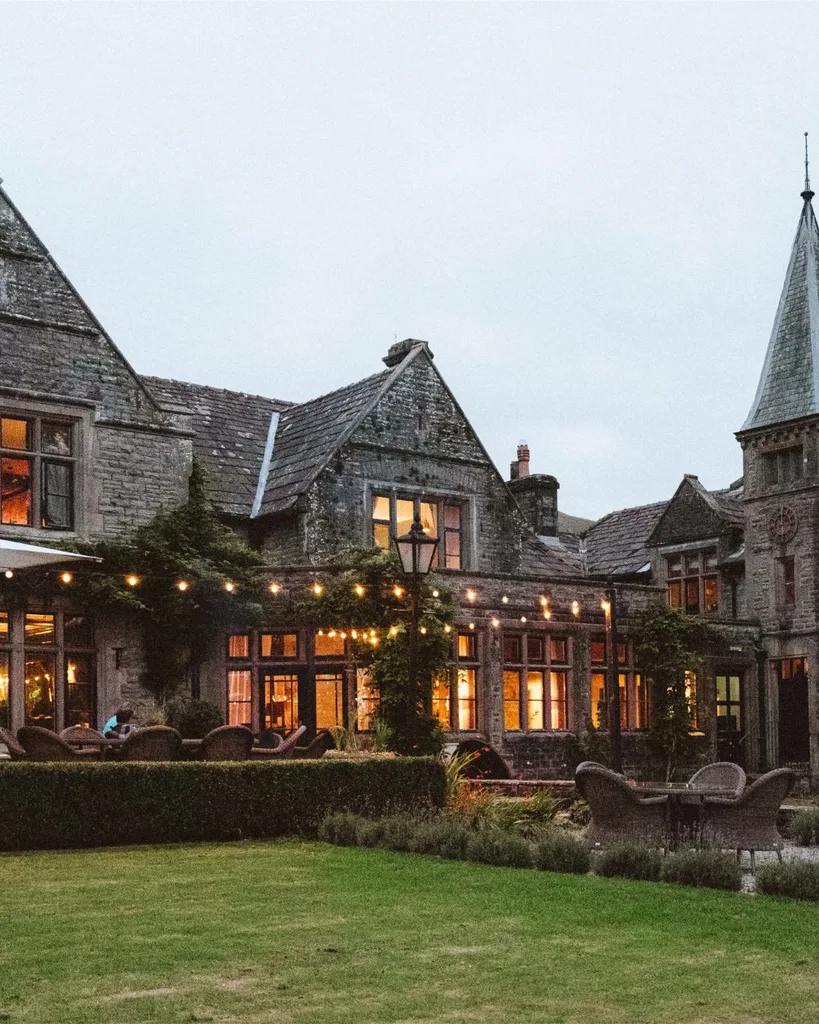
Fifteen kilometres west over the vertiginous Buttertubs Pass lies Hawes, a bustling market town that’s the Dales’ de-facto hub. On a fellside above, Simonstone Hall is perhaps the park’s canniest place to stay in terms of its location at the centre of everything, and certainly among its most relaxing. “We’re trying to de-hotel the hotel and to avoid anything pretentious,” says Jake Dinsdale, its 36-year-old owner. “I want this to be an authentic, laid-back country-house stay, run by a young, fun team.” A local lad, Dinsdale spent time working in London and Ghana, returning to the Dales a decade ago to snaffle this wide, caramel-stone manor house, and leaning on his design background to smarten it up.
The result fuses baronial class – stag heads; four-poster beds; free-roaming peacocks – with modern country cool, as seen in the fairy-lit terrace’s wood-fired hot tub and the navy panelling of the lounge. Jaw-dropping valley views abound, as do cosy corners. Championing seasonal produce from neighbouring farms and fields, inventive plates such as lamb rump alongside chicory marmalade or blue cheese-and-chorizo burgers are delivered by personable, pleased-to-be-there servers. A single refreshing principle anchors it all.
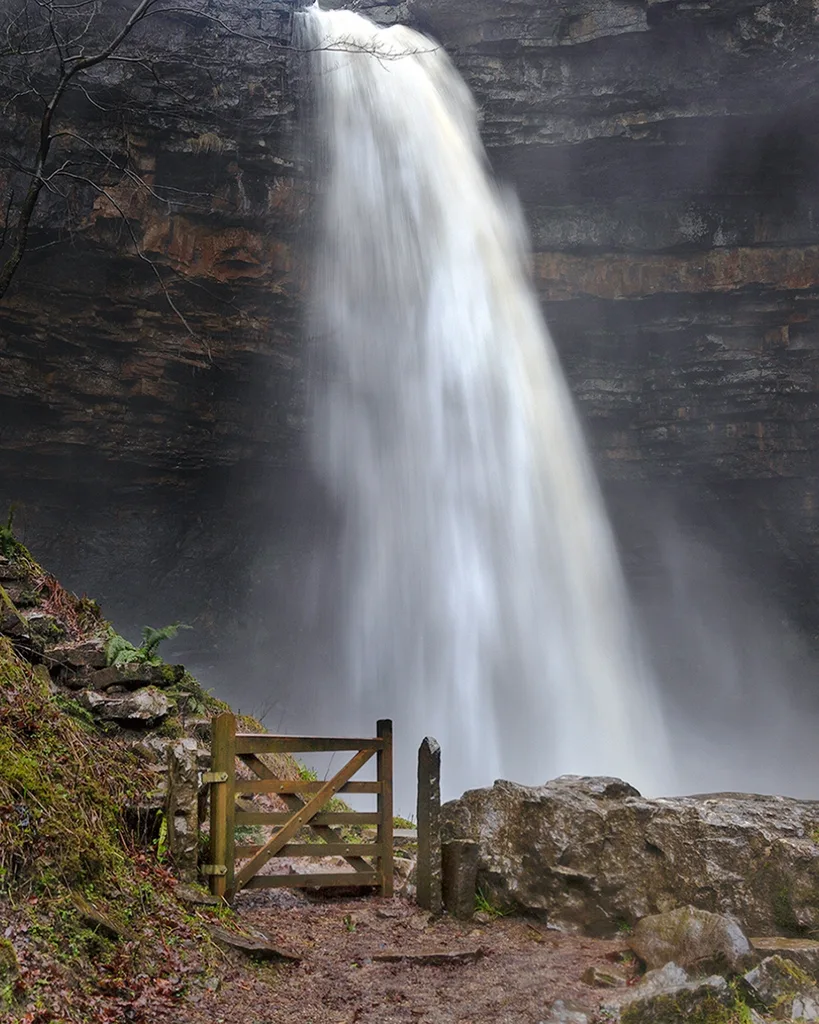
“Everybody’s treated similarly,” says Dinsdale. “Aristocrats and celebrities get the same service as Bob and Sue with their muddy wellies and wet dog.” Even Robbie, Fennell and co, when they stayed here during filming? “Even them.” Audible from that hot-tub terrace is Hardraw Force, a tree-hugged, 30-metre waterfall in whose cavernous hollow Kevin Costner’s outlaw skinny-dipped during Robin Hood: Prince of Thieves. Further down the same valley, Wensleydale, are Aysgarth Falls’ three successive, gentler cascades and then the mostly intact remains of Bolton Castle, where Mary Queen of Scots was imprisoned for six months.
Up at Wensleydale’s head in Hawes, I find old-fashioned tea rooms, a century-old ropemaker’s shop and a creamery producing the valley’s namesake cheese. Happily, tastings are available, and at the café I try an unexpected Yorkshire tradition: slices of crumbly Wensleydale atop rich fruitcake.
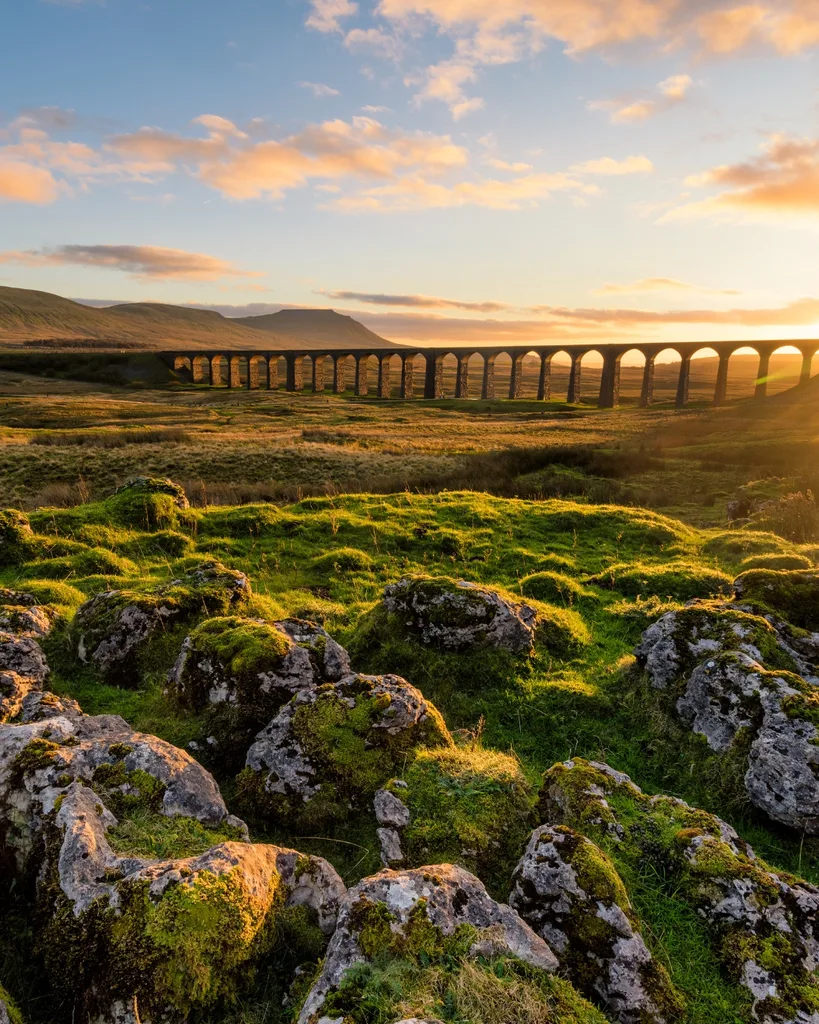
Three of the Dales’ headline sites are a 20-minute drive to the west. First up is grand Ribblehead Viaduct, a 24-arch, 400-metre colossus on the oh-so-scenic Settle–Carlisle railway. It’s best appreciated from below, on foot, or, as I opt for, over a steak and ale pie in the popular Station Inn’s garden. Equally chockers are the paths ascending the so-called Yorkshire Three Peaks – Ingleborough (723 metres), Whernside (736 metres) and Pen-y-ghent (694 metres) – whose summits hardy types attempt to collectively tick off inside 12 hours, just for fun.
One of the area’s characteristic limestone pavements – naturally formed slabs of silvery stone, fissured with greenery – crowns Malham Cove. With its startlingly sheer, 80-metre cliff, it’s attractive, yet hardly unique, leaving me puzzled as to why this pocket of the Dales is so markedly busier than almost anywhere else. Jonathan Smith, whose company Where2Walk offers guided and self-guided walks across the park, has a theory.
“Increasingly, people solemnly follow prescribed routes via apps like Strava, but this means everyone goes to the same places,” he says. “Effectively, we’re seeing a variation of the 95/5 rule, with 95 per cent of tourists in 5 per cent of the Dales. The rest is largely empty. “If you can navigate properly – read a map and use a compass – it’s easy to escape,” Smith continues. “Instead of walking to Malham Cove, go in the other direction, to Weets Top. It’s an easy hike, and even on a Saturday in August you’ll have a fantastic viewpoint all to yourself.” For a comparably quiet limestone pavement, he has me head 20 kilometres west to the Ingleborough area and aim slightly north of Long Scar. “There’s a beautiful path which cuts right through. You get this expanse of rock with some small hawthorne trees adding a nice perspective. It’s breathtaking. And quiet.”
Having unearthed the Dales’ ultimate walk, it would be rude not to follow it up with a visit to the quintessential country pub in Wharfedale, a southeastern valley whose 32-kilometre stretch encompasses chunky crags, pretty village after pretty village and Bolton Abbey’s 12th-century ruins. Close by, in a sleepy hamlet called Appletreewick, I find the Craven Arms, whose wood-beamed, flagstone-floored interior positively screams “olde England”. Gas lamps and cast-iron ovens further this snug spell; so too does a fruity pint of Old Peculier cask ale from local brewer, Theakston’s.
Taking a sip outside, I gaze hypnotised as sunlight suddenly illuminates the moody grit ridge ahead. Noticing my pleasure, a villager offers up a succinct, archetypally Yorkshire summary. “No’ bad, eh?” he suggests, with only a twinkle in his eyes revealing the understatement. “Not bad,” I agree

Related stories
Native ad body.
Native ad body.

On the Road: Touring the best of Tasmania

Native ad body.
From Bucket List to Boarding Pass — on Your Terms