
 Eric Micotto
“A sensitivity to ephemera.” That is the rough translation of a concept called mono no aware that permeates Japanese culture. It’s the bittersweet awareness of impermanence, the burst of joy mixed with a gentle sadness that comes from witnessing the transience of nature. A frog breaking the stillness by jumping into a pond; sparkling dew drops dissipating into the atmosphere under the sun; the last of the momiji leaves falling from their branches ahead of winter – all things that have represented mono no aware in Japanese poetry, art and literature for centuries. It is also the most poetic way to describe what it’s like to take a day trip through bustling Tokyo to the serene foothills of Mount Fuji, in pursuit of a famous vista that may or may not show itself.
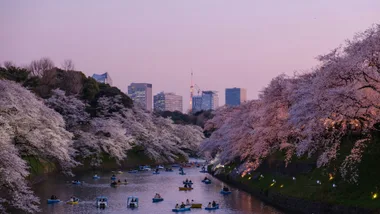
Japan, on the eve of sakura season, is in a state of suspense. For the Japanese, the short-lived blooms serve as a reminder to cherish the present, marking the arrival of spring with a romantic intensity that captures the nation as it unfolds. Tourists travel across the world to witness it; news bulletins track the blooms’ progress across the country like a weather front; and the city bursts into theme accordingly. At The Peninsula Tokyo in the heart of Marunouchi, the foyer has been transformed: fresh cherry blossom trees and artistic installations in pale pink adorn the entrance and menus reflecting springtime flavours are now being served; signals that the season, though only in its early days, is already being celebrated.
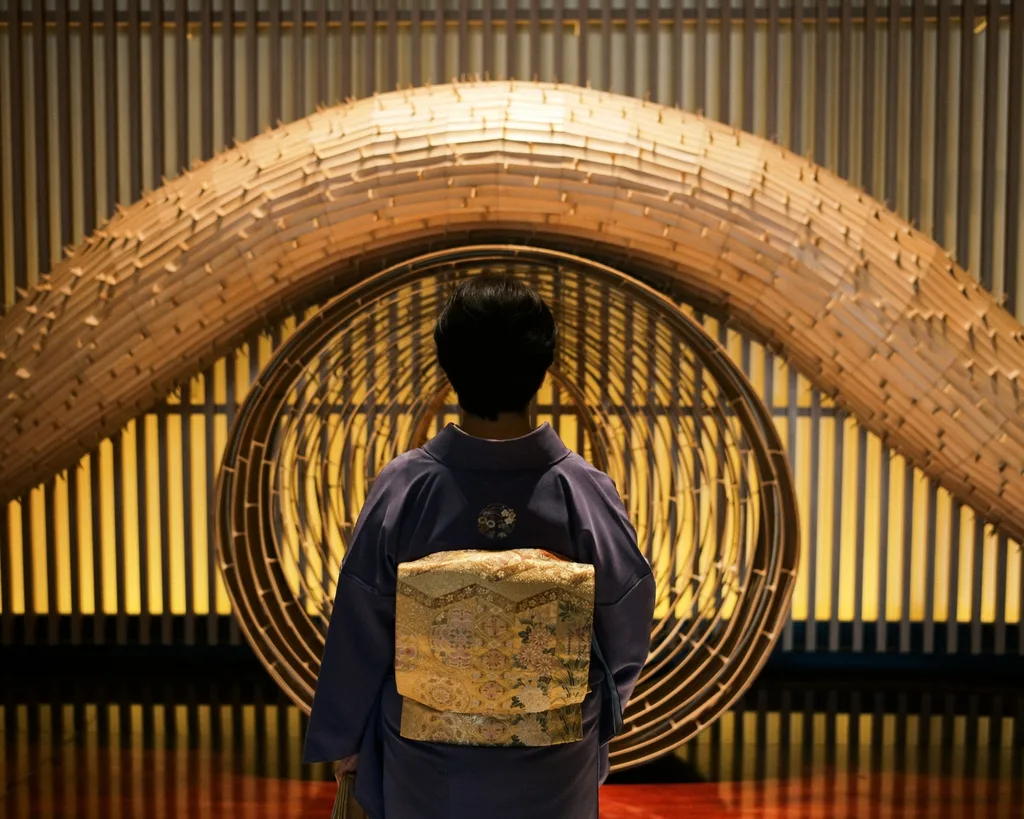
Designed by architect Kazukiyo Sato and interior designer Yukio Hashimoto, every element of The Peninsula Tokyo is sublimely Japanese, from the front façade, conceived to rise like a lantern above the street, to a lobby that emulates the torii gates of traditional shrines, and the nearly 1000 artworks that line its halls. The rooms and suites, which overlook the Imperial Palace Gardens, are among the most thoughtfully spacious and serene in the city. Traditional woodwork, red lacquered tables, sliding doors milled from single pieces of horse chestnut, washi paper details, and lovely tactile writing stationery all echo centuries of craftsmanship. And then there are the technology details – a personal fax machine, panels of millennial-era room controls that include a “spa mode” that dims the lights and pipes calming music into the bathroom, and hi-fi media access for every room – charming time capsules that affectionately reflect Japan’s relationship with its recent techno-past.
Aside from its bucket-list status, The Peninsula also has a deep appreciation of fine automobiles. Around the world, its hotels host awards for automotive luminaries and classic car specimens and in Tokyo, it’s a chosen stay for well-heeled enthusiasts to experience Japan’s thriving motorsport and car culture scene. The hotel even has a semi-annual signature Japan Driving Experience, where guests can join a regional road trip by importing their own cars or renting something special, locally.
Our chariot for the visit is a Rolls-Royce Black Badge Cullinan – the British marque’s super-luxury SUV. It’s greeted enthusiastically by the hotel staff, and turns many a head on the street, even though a Rolls-Royce in these parts is not such a rare sight. Peninsula hotels and Rolls-Royce have enjoyed a relationship for more than half a century, which endures to this day: hotel guests can experience the marque via its in-house bespoke Rolls-Royce Phantoms – part of the only customised hotel car fleet in Japan. In addition, the hotel’s pride and joy, a grand and immaculate 1934 Rolls-Royce Phantom II can be booked for weddings, and can be viewed in its garage upon request.
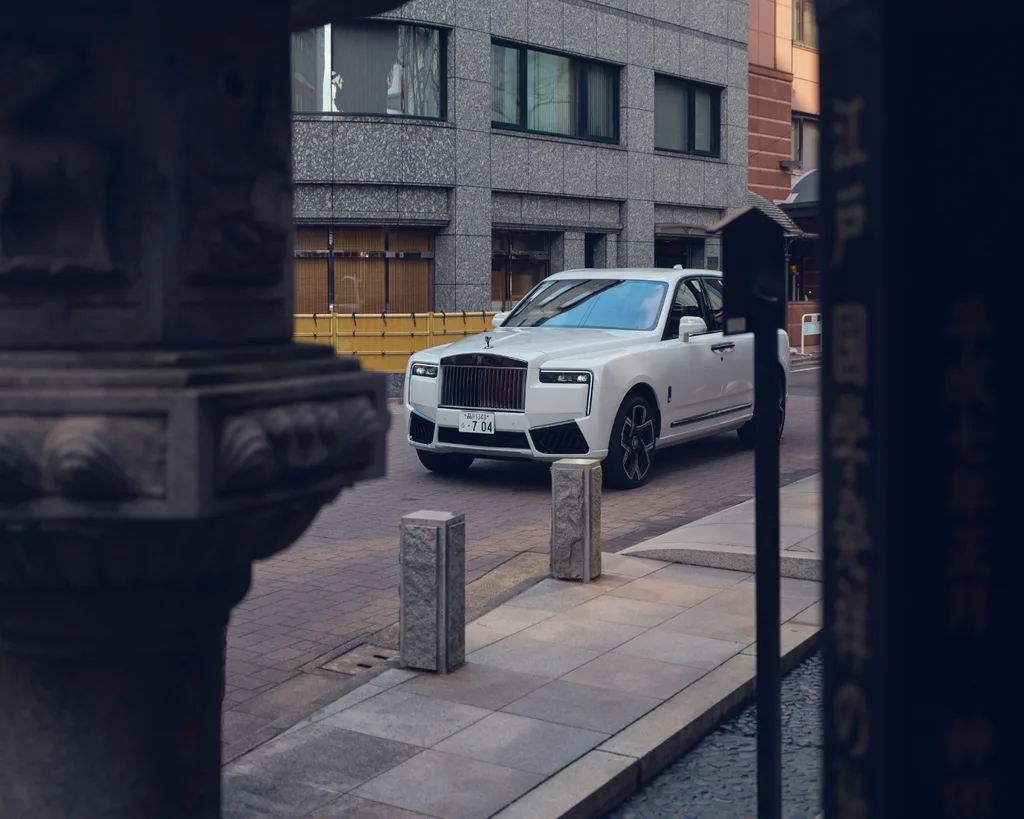
Compared to the elegant restraint of the hotel cars, our Cullinan is 591 horses of a different colour. The exterior is a clean, arctic white that is elegant and composed. However, open the coach doors, and you’re greeted with a shocking neon lime green and black interior, with dark metal touchpoints, carbon-fibre surfaces, and the iconic starlight headliner with shooting stars on the roof and rear boot door. The seats are embroidered with the marque’s Duality Twill, an abstract interpretation of two interlinked “R” initials. Made from bamboo-derived rayon, each piece takes 20 hours of hand-stitched embroidery work, up to 2.2 million stitches and 17.7 kilometres of thread. In this amplified and unapologetic interior spec, the car feels alive with the same energy as Tokyo after dark. That’s because this is a Black Badge, which Rolls-Royce refers to as its “alter ego” offering; a more subversive alternative to its classic line-up easily spotted by its black exterior metal details and Spirit of Ecstasy hood ornament, elements that would usually appear in chrome. Black Badge was introduced in 2016, after Rolls-Royce noticed a more rebellious customer emerging; one that rejected the clichés of luxury-past and sought a more contemporary vision for their cars. Think: more technical materials, disruptive colourways and more interesting expressions of luxury. It is an almost absurdly apt metaphor for Japan. Not only because we are sitting within a machine made with a commitment to exquisite craftsmanship. But because on the outside it presents as one thing, though, climb inside, pay attention to the details, and it reveals something else altogether. Much like the country itself.
Our day trip will take us into the mountains on the borders of the Kanagawa prefecture and into Yamanashi. This area is known for wine and sake production and the Fujigoko, or the five lakes of Fuji, though we’re here to try our luck capturing the elusive Mount Fuji, if the famously shy mountain dares to show itself from behind the clouds. In the early morning light, we make a pilgrimage for good luck to Kanda Myojin, one of Tokyo’s oldest Shinto shrines and a hidden sanctuary near the busy tech hub of Akihabara, watching locals bow at its vermilion gate, enter to take a moment of pause, and go on with their day. A handful of cherry blossoms have already opened around the ancient courtyard – the first sakura of the journey.
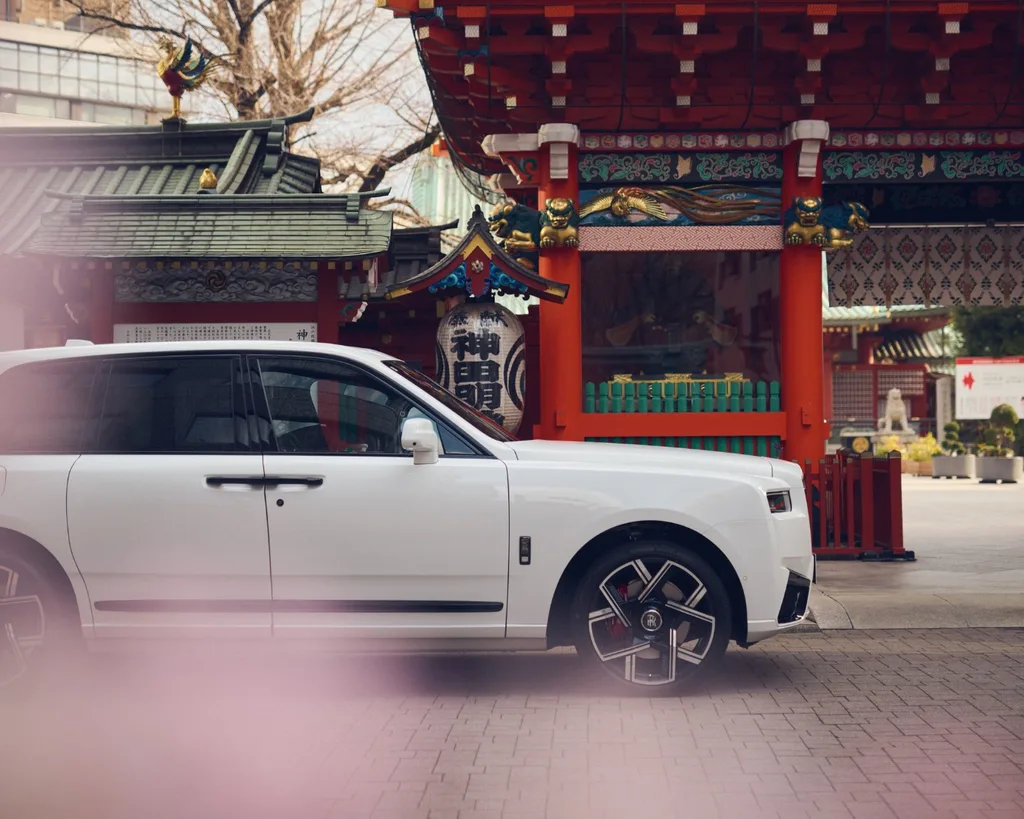
The Cullinan has already made a formidable first impression, navigating the tight backstreets of Tokyo. At 5.34-metres long, a Japanese Kei car it is not., but any intimidation we had around size dissipates quickly. A combination of Rolls-Royce’s famously effortless but extremely direct steering feel, coupled with rear-wheel steering and a wide-lens camera that actually shifts its view as you drive, results in shockingly easy manoeuvrability. In any other car, rush-hour Tokyo would be painful, but the Cullinan’s luxurious genius reveals itself fast – the near-silent cabin, as an insulator from the world outside; the extremely powerful 6.75-litre V12, which barely registers above a whisper; the famous Rolls-Royce self-levelling “magic carpet ride” suspension, which feels like you’re gliding on air (technically, you are); and of course, the seats that can be individually configured to meet any comfort need. In gridlock, we test out the acoustics – an 18-speaker Bespoke Audio system with a 1400-watt amplifier. It’s so refined in its engineering that the aluminium sills within the car are actually designed to act as resonance chambers for the low-frequency speakers, meaning the entire car functions as a subwoofer. Genius.
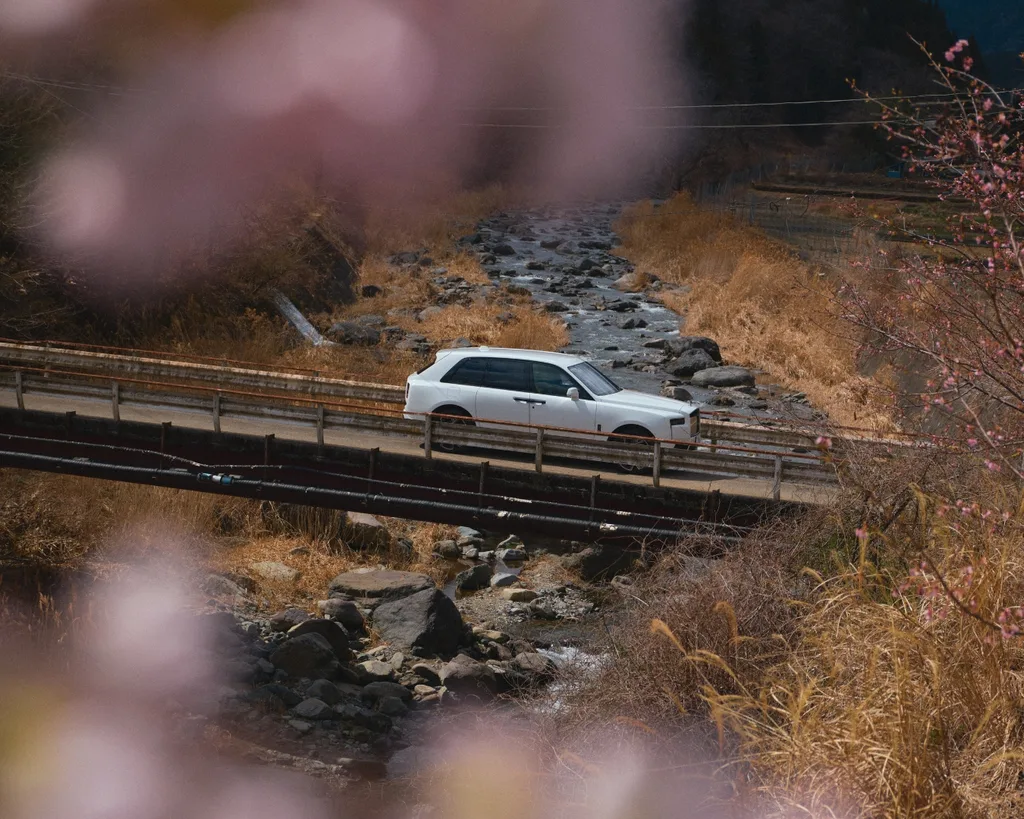
The expressways eventually clear, and somewhere around Lake Sagami, we enter a tightly wound mountain road known as Route 413 or Dōshi Michi, a popular cycling route used for the 2020 Tokyo Olympics and an incredible driving road. Dōshi village sits in the far southeastern corner of Yamanashi Prefecture, deep in the Tanzawa Mountains, and though it’s around two hours from central Tokyo, it feels much more remote. Our Cullinan, feeling very out of place in this popular camping region, passes eerie cedar forests, rushing river valleys, the odd pathway leading to a shrine and small towns that appear briefly between the trees. The landscape is shedding winter: brown, bare, with only occasional pale clusters of sakura appearing on the side of the road. The Cullinan handles the tight turns and uneven mountain roads with impressive composure – its technology has the ability to read the road ahead and adjust the chassis with each imperfection, while inside the cabin, we’re unaware any of this engineering trickery is happening.
As we descend from the mountains towards Lake Yamanakako, Fuji-san makes its first appearance, rising behind the tree line in glimpses, its upper peak hiding behind cloud. The forecast had predicted cloud and rain, and for a moment, it seemed that might be the case. Then, as the largest of the Fuji Five Lakes opens up before us, the cloud shifts. We pull off the road and onto a viewing point on the dark, sandy shore – an easy manoeuvre for our sublime off-roader – step out, and there it is: Fuji-san in full, snowcapped dress, towering above the lake in mesmerising grandeur, clouds on either side threatening to take away the view – mono no aware, in action, making it all the more arresting.
Above the lake via another short mountain climb, and where remnants of winter snow are still on the ground, is the Yamanakako Myojinyama Panorama-dai lookout. We were told it’s worth stopping to see Fuji-san in full view and we’re not disappointed. Though the mountain has become bashful again, hiding behind a stripe of cloud, the view is still magnificent, the lake, peak and sky arranged like a painting.
After stocking up our rear-seat Champagne fridge with snacks from the local Family Mart, we turn back toward Tokyo and the Cullinan settles into its long-distance rhythm again; that mighty, silent V12 pulling smoothly through the last of the mountain roads and back onto the expressway. The setting sun catches the Spirit of Ecstasy on the hood, casting her briefly in a dark-tinged rose gold and our starlight headliner sparkles as the light fades, the city rises up to greet us, and we hit the evening gridlock – again, grateful that our borrowed steed happens to be the finest way to get stuck in traffic.
A Rolls-Royce may not be the most obvious car for rural Japan, and one might argue that, like the hotel cars, few may even venture out to the roads less travelled. But then, mono no aware isn’t about the expected. It is about what arrives briefly and asks only that we notice. And in a country that treats the handmade as a form of devotion and finds meaning in the details often overlooked, on a journey that wasn’t meant to unfold as it did, a hand-built, hyper luxury SUV with a neon green interior felt, oddly, quite right.